In her book Citizen: An American Lyric, Claudia Rankine explores the implicit and explicit racisms of everyday American life which render some citizens politically invisible. Her book asks us to think about who is able to speak, act, and live in the 21st century US—and whose speech, actions, and life appear as something less than real, as “mere fictions” to the state.
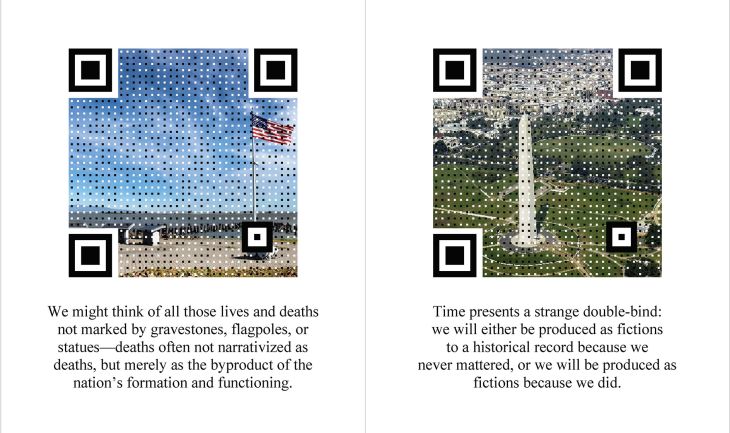
This public artwork, How does it feel to be a fiction? New Haven Virus by Aliza Shvarts, explores the consequences of living as a “fiction” to power, to history, and to each other. Because digital spaces are the new civic spaces (increasingly, we share ideas, argue, and encounter each other not in the town square, but online), this work entails three interrelated components: a digital performance which unfolds through email; a physical structure on the New Haven green; and an interactive installation which will be installed throughout the city.
How does it feel to be a fiction? was originally commissioned by Recess (NYC) after the 2016 presidential elections as part of a project exploring the role of “fake news.” Since then, there have been several different iterations of the work. For each iteration, Aliza Shvarts write a new text based on the context of the hosting institution, which is disseminated as part of the digital performance. She also creates a new installation to accompany the work. For How does it feel to be a fiction? New Haven Virus, which is the third iteration of this piece, the text will address the fiction of national belonging.
To participate in the digital performance, visit: howdoesitfeeltobeafiction.org.
To participate in the public event on the Green, please meet at the WWI Memorial Flagpole at 12:30pm on June 16th. The event will last approximately an hour.